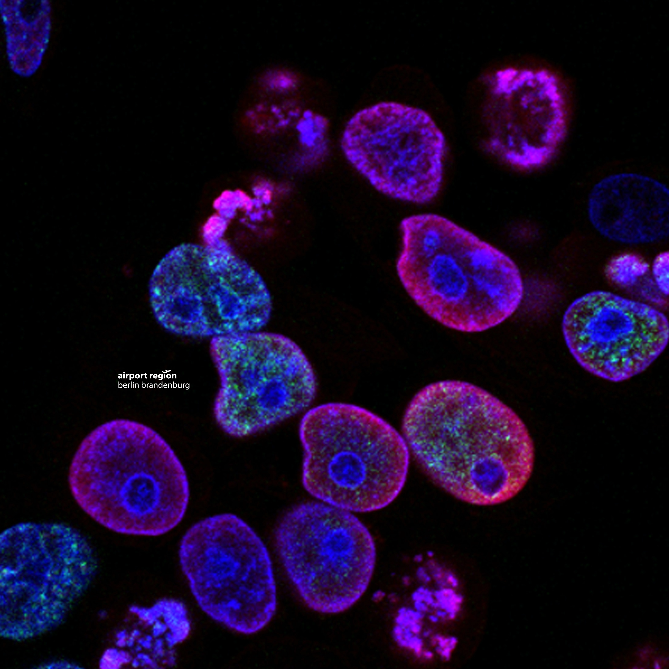
© National Cancer Institute NCI - unsplash I Layout: ARBB - Melanie Gartzke
In Potrait: Ariceum
Berlin-based Ariceum Therapeutics focuses on radiopharmaceuticals in the fight against difficult-to-treat cancers. It plans to have products on the market by 2028. Ariceum is well on its way to achieving this goal, having found financially strong partners and investors who will enable it to continue its advanced development.
Radiotherapy is still one of the methods of choice for fighting cancer cells. "The problem with this external approach is that it only catches a few larger solid tumours that can be palpated or visually located," says Manfred Rüdiger, CEO of Ariceum. "You can't catch the very small metastases or clumps of cells."
Going straight to the tumour cells
Instead of delivering radiation from the outside, Ariceum's products aim to deliver radiotherapy and radiation directly to the cancer cells. "Put simply, this is how it works," says Rüdiger. "We develop a molecule to which we attach radioactive emitters and administer it intravenously. Because of its surface structure, this molecule finds the tumour cells in the body, sits on them and kills them. We are initially focusing on small cell lung cancer and neuroendocrine tumours.
According to Rüdiger, the technology has two major advantages over conventional radiotherapy: First, it kills almost exclusively the tumour and hardly any surrounding healthy cells. Second, it reaches tiny tumour cells that are otherwise invisible or undetectable. Radiopharmaceuticals therefore have a dual function - they are either diagnostic or therapeutic, depending on the emitter or isotope used.
The approach with radiopharmaceuticals is not entirely new. Novartis now has two approved therapeutics that are already being used successfully against slow-growing tumours. Ariceum - the name is an anagram of two-time Nobel laureate Marie Curie - also did not start from scratch when it was founded in 2021. "We bought the product out from Ipsen Pharma at the development stage with all the rights at the time and set up with the mission to develop the molecule further."
Numerous investors and partners
Since founding the company and taking over as CEO, Rüdiger, who has a doctorate in biochemistry, has been busy forming partnerships, attracting investors, giving talks and bringing new experts on board. All of this has obviously paid off, as the list of collaborations is long: In May of this year, a research collaboration with the biopharmaceutical company UCB was announced; in June, the private biotech company Theragnostics was acquired; and since the end of June, Ariceum has been working with the service provider Eurofins CDMO to support clinical trials. There are also two commercial partnerships with Novartis and GE Health.
In addition to Ipsen Pharma, Ariceum's investors include EQT Life Sciences (formerly LSP), HealthCap, Pureos Bioventures, Andera Partners and Earlybird Venture Capital. In April, it was announced that Ariceum had successfully completed a second round of financing of €22.75 million, following a first round of financing (Series A) of €25 million. Ariceum needs the money for further research and development and, above all, to finance the approval of the drug. Ariceum already has revenues from its commercial partnership with GE Health. But this is not enough to fund large development programmes. "We have now enrolled the first patient in the small-cell lung cancer trial," says Rüdiger. "We expect to be able to bring our product to approval in 2028."
Future focus: further development of the product
Rüdiger leaves open the question of whether Ariceum will be sold to a large pharmaceutical company or possibly floated on the stock market: "For now, we want to focus on generating data and developing the product," he says. "Of course, the big companies have more money behind them and can build up supply chains more quickly, for example. But in the small companies, the necessary decisions can be made much faster, and that is where the innovation takes place".
Ariceum currently has 20 employees. "Some of them are based in Switzerland, where we have taken on colleagues from other pharmaceutical companies," says Rüdiger. "The rest research and work at the headquarters in Berlin-Buch - a good location because there is a lot of good research going on here and, not least, a lot of good funding opportunities, such as the support from Berlin Partner."
A location for the pharmaceutical industry with a long tradition and dynamic innovation
The sustained success of the pharmaceutical industry in Berlin-Brandenburg is based on innovative products and a history dating back to the 19th century. The industry benefits from an excellent scientific and clinical environment and proximity to decision-makers in the German healthcare system. In addition, the geographic location of the German capital region provides good access to Western, Central and Eastern European markets. Global players such as Astra Zeneca, Bayer, Berlin-Chemie (Menarini), Daiichi Sankyo, Pfizer, Sanofi and Takeda, as well as more than 20 medium-sized pharmaceutical companies, are based in Berlin-Brandenburg and employ around 10,000 people.
The close link between research, development and clinical practice is also reflected in the successful and well-established translational research, the excellent infrastructure for technology transfer and the many opportunities for conducting clinical trials in the region. With a large and diverse patient population and more than 130 clinics, the Berlin-Brandenburg region enables all types of clinical research projects.
No. 1 for clinical studies in Germany
Berlin has the highest number of clinical studies in Germany (as of 2016). The main driver is the Charité, Germany's largest and most prestigious university hospital. The Charité Research Organisation (CRO), a subsidiary of the Charité, also plays a key role. As a service provider for the conduct of early clinical trials - from first time in human (FTIH) to proof of concept (PoC) - its main task is to conduct complex clinical trials with a translational approach in many therapeutic areas. Around 20 other clinical research organisations, including Parexel, are based in the capital region, employing more than 1,000 people.
For more information on the economic development of the region's growth industries, business and technology support for companies, investors and scientific institutions, please contact:
Melanie Gartzke I melanie.gartzke(at)airport-region.de
Source: Cluster HealthCapital Berlin Brandenburg www.healthcapital.de, “In Portrait | Ariceum - Targeting and eliminating cancer cells” published on July 17,2023 ) 18, 2023