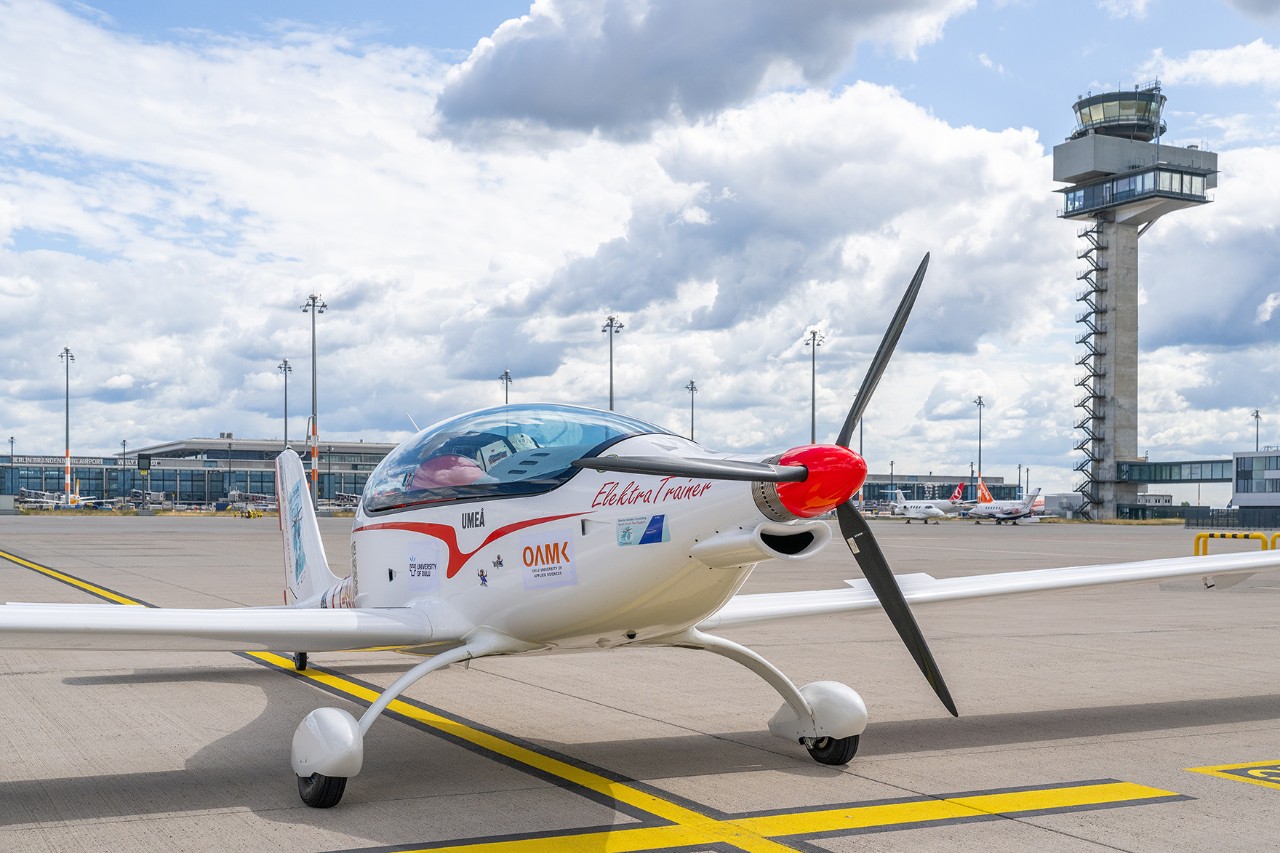
Fliughafen Berlin Brandenburg GmbH | Günter Wicker
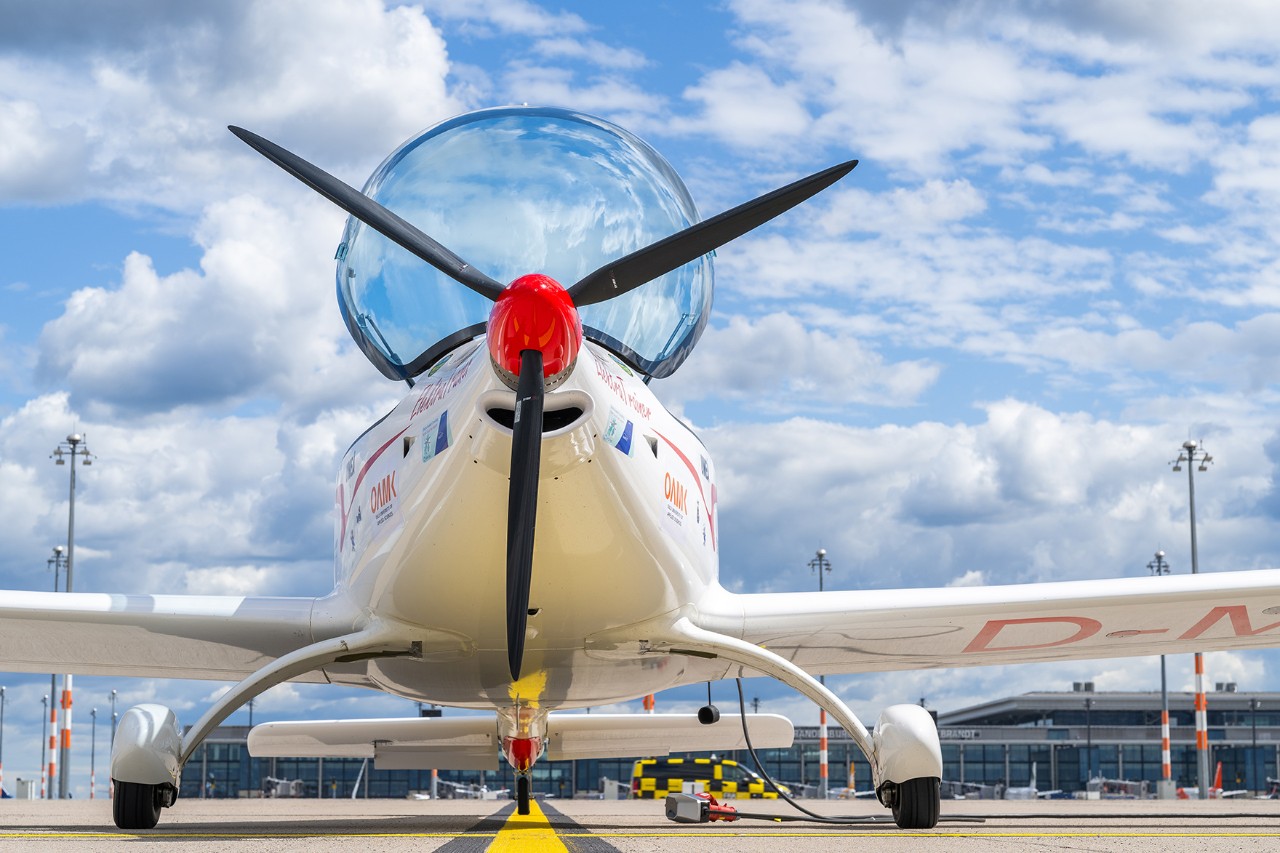
Fliughafen Berlin Brandenburg GmbH | Günter Wicker
All-electric aircraft lands at BER for the first time during regular operations
On Tuesday, 21 July, a fully electric aircraft landed at Berlin Brandenburg Airport for the first time during regular airport operations. Pilot Uwe Nortmann is currently travelling across Europe in a two-seat aircraft called the Elektra Trainer. Over the course of the journey, he aims to cover a total distance of 5,600 kilometres using electric power, setting a new record in the process.
The electric aircraft was welcomed by CEO Aletta von Massenbach together with representatives from the airport’s Sustainability Management team. The journey began on 2 July in Memmingen and has taken the pilot through Denmark, Sweden, Finland, Estonia, Latvia, Lithuania and Poland before arriving in Berlin. The aircraft will continue its journey from BER towards southern Germany on Tuesday.
Two Seats and a Range of Around 300 Kilometres
The fully electric Elektra Trainer has seating for two people. According to the manufacturer, the ultralight aircraft has a range of approximately 300 kilometres and can remain airborne for up to two and a half hours.
Its typical cruising speed is around 120 kilometres per hour, while its maximum speed is approximately 170 kilometres per hour.
Electric aircraft are significantly quieter than conventionally powered aircraft. According to the manufacturer, the Elektra Trainer produces less than 50 decibels of noise, comparable to moderate rainfall. The aircraft generates no CO₂ emissions during flight.
Handled Using Existing Infrastructure
At BER, the handling of the small electric aircraft follows essentially the same procedures as those used for larger aircraft. No special charging infrastructure is required for this type of aircraft.
The aircraft can be charged using a standard 16-amp electrical socket. Suitable charging points are already available at BER.
CO₂-Free Electricity Supply
The electricity used to charge the aircraft at BER is also provided on a CO₂-free basis.
More than 50 per cent of Germany’s electricity mix comes from renewable sources. The non-renewable share is offset at BER through guarantees of origin certified by the German Environment Agency (Umweltbundesamt).
In addition, four photovoltaic systems with a combined capacity of 2.5 megawatt-peak feed electricity into the Flughafen Berlin Brandenburg GmbH grid. Further solar installations are currently being planned and implemented.
Electric Aviation in Practice
The visit by Uwe Nortmann and his Elektra Trainer is currently a one-off event. However, the landing demonstrates how electric light aircraft can already be operated and handled using existing airport infrastructure.
The wider introduction of series-produced electric aircraft is expected in the early 2030s. Flughafen Berlin Brandenburg GmbH is therefore already examining the long-term charging and handling infrastructure that will be required.
The Elektra Trainer is scheduled to depart BER again on Tuesday and continue its journey towards southern Germany.
For more information on the region's economic development or support for businesses, investors, and research institutions, please contact:
Sandra Koletzki | sandra.koletzki(at)airport-region.de
(Source: Flughafen Berlin Brandenburg GmbH, 07|21|2026 | “Elektrische Premiere am BER | E-Flugzeug macht Station in Berlin”)